
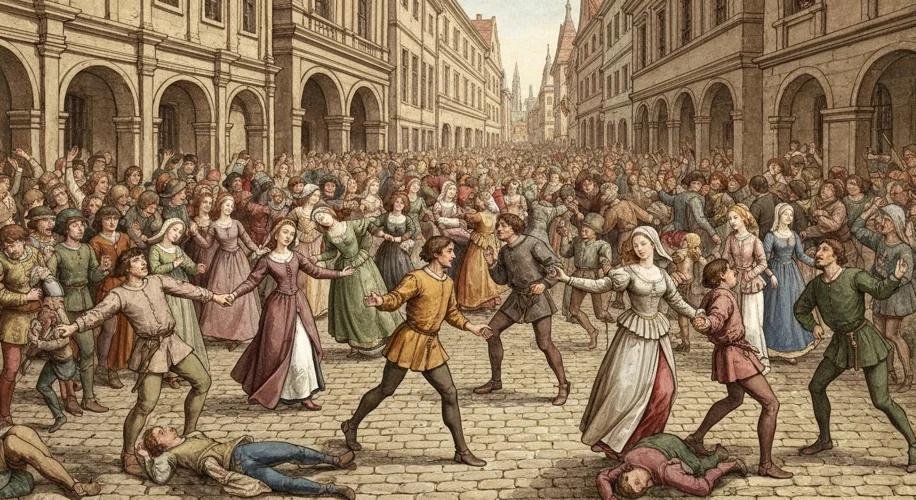
In the summer of 1518, something bizarre began happening in the streets of Strasbourg, then part of the Holy Roman Empire.
A woman known in historical accounts as Frau Troffea reportedly stepped outside and began dancing uncontrollably.
There was no celebration and apparently no music driving her movements.
According to contemporary accounts, she continued for several days.
Then other people began doing the same thing.
Within weeks, dozens—and possibly hundreds—of people were reportedly caught up in the strange episode. Some accounts describe people dancing for days, collapsing from exhaustion, and being unable to voluntarily stop.
The city’s authorities had no idea what was happening.
Their response makes the story even stranger.
Some local officials apparently believed the afflicted people needed to dance continuously until the condition passed. Musicians were brought in, and spaces were made available for the dancers.
Instead of solving the problem, the response may have encouraged the phenomenon to spread.
The outbreak eventually faded, although the exact number of deaths remains uncertain.
So what caused it?
One leading modern explanation is mass psychogenic illness, in which psychological stress can produce genuine physical symptoms across groups of people. Strasbourg had recently experienced famine, disease, extreme hardship, and religious anxiety, creating an environment in which such an unusual episode might have emerged.
Other theories—including food poisoning and neurological illness—have been proposed, but none has been conclusively proven.
More than 500 years later, the Dancing Plague remains one of history’s strangest mysteries.