
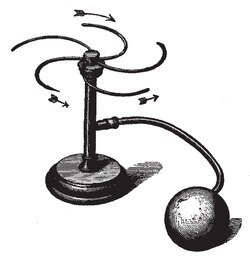
One of physics’ most famous unanswered questions—known as “Feynman’s Sprinkler Problem”—has finally been resolved more than 80 years after it first puzzled Nobel Prize-winning physicist Richard Feynman.
In the early 1940s, while working at Princeton University, Feynman became fascinated by a simple question: If a sprinkler normally spins one way while spraying water outward, which way would it rotate if it sucked water inward instead? To find out, he reportedly built a glass sprinkler and connected it to run in reverse. Before the experiment could provide a clear answer, however, the glass apparatus shattered under pressure, leaving the mystery unsolved.
The problem went on to become one of the most famous thought experiments in fluid mechanics. Over the decades, physicists proposed competing explanations involving pressure differences, water flow, and conservation laws, but no consensus emerged. The question became a classic example of how even seemingly simple systems can hide surprisingly complex physics.
That changed in 2026, when researchers at New York University Courant Institute of Mathematical Sciences, led by Leif Ristroph and colleagues Jesse Smith, Mingxuan Zuo, Will Kuhlke, and Brennan Sprinkle, designed a new series of experiments using inexpensive looping plastic lawn sprinklers—the colorful “silly sprinklers” commonly sold in hardware stores.
By building customized versions that could both expel and draw in water, the team carefully measured how the devices rotated under different conditions. Their experiments showed that the motion is governed primarily by momentum flux—the transfer of momentum carried by moving water—rather than by the external water flow explanations that had dominated scientific debate for decades. Their results provided the first comprehensive experimental confirmation of how the reverse sprinkler behaves.
The findings were published in the Proceedings of the National Academy of Sciences, and physicist Detlef Lohse described the mystery as effectively settled, stating that Feynman’s original problem had finally been solved.