
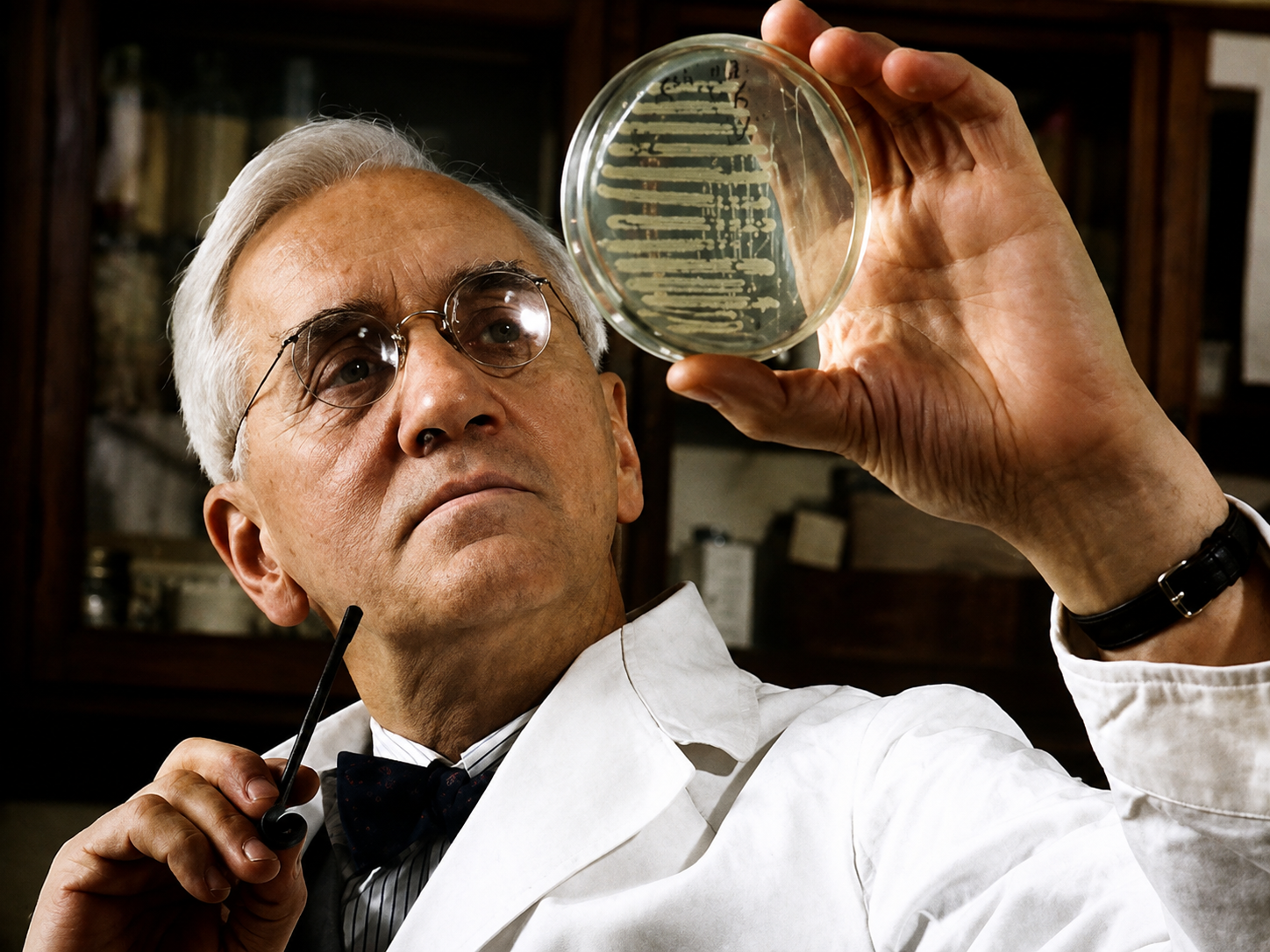
In 1928, Scottish bacteriologist Alexander Fleming returned to his laboratory after a vacation and noticed something unusual in one of his Petri dishes.
A mold had accidentally contaminated a culture of Staphylococcus bacteria. Around the mold, the bacteria had been killed, while those farther away continued to grow. Rather than discarding the contaminated dish, Fleming investigated the phenomenon and identified the mold as Penicillium notatum, naming the antibacterial substance it produced penicillin.
Although Fleming made the initial discovery, turning penicillin into a practical medicine required the later work of Howard Florey, Ernst Boris Chain, and their colleagues, who developed methods to purify and mass-produce the drug.
During World War II, penicillin revolutionized medicine by dramatically reducing deaths from bacterial infections and wound-related complications. Its success marked the beginning of the antibiotic era and transformed modern healthcare.
In 1945, Fleming, Florey, and Chain shared the Nobel Prize in Physiology or Medicine for their contributions.