
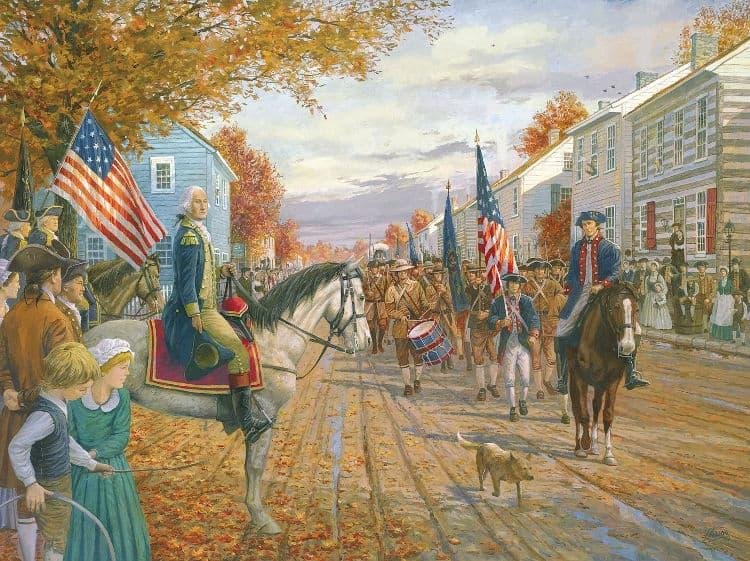
In 1794, the young United States faced a crisis that threatened to test whether its new federal government could actually enforce its own laws.
The controversy began with the Whiskey Tax, an excise tax imposed on distilled spirits as the federal government struggled to pay debts left from the Revolutionary War. For many farmers in western Pennsylvania, whiskey was more than a drink—it was an important form of currency and a practical way to transport surplus grain to market.
Resistance quickly became violent. Protesters attacked tax collectors, intimidated government officials, and destroyed property associated with tax enforcement.
President George Washington initially attempted to resolve the crisis peacefully. When negotiations failed, he invoked federal authority and called up approximately 13,000 militia troops from several states.
In an extraordinary scene, Washington personally rode with the army into Pennsylvania, making him one of the very few sitting American presidents to personally accompany troops during a domestic military operation.
But there was no dramatic battlefield showdown.
By the time the federal forces arrived, the rebellion had largely collapsed. Washington later transferred command to Henry Lee, and most of the resistance disappeared without a major battle.
Only a small number of participants were eventually prosecuted, and President Washington later pardoned two men who had been convicted.
The rebellion became a crucial early test of American federal power. The government had demonstrated that, unlike the weak national government under the Articles of Confederation, the new constitutional system could collect taxes and enforce federal law.
Washington’s decision was therefore about much more than whiskey. It helped establish an important precedent: the laws of the new United States.