
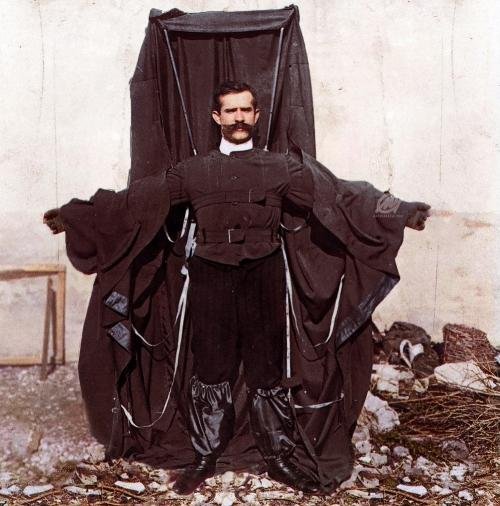
On February 4, 1912, Austrian-born French tailor and inventor Franz Reichelt climbed to the first platform of the Eiffel Tower wearing a parachute-like suit he believed could help aviators survive a fall from an aircraft.
Reichelt had spent years developing the unusual invention. The garment was designed to unfold into a large parachute when the wearer jumped, allowing the person to descend safely to the ground. He had already conducted experiments with dummies and had even tested some versions himself, but the results had not demonstrated that the design could reliably slow a fall.
Despite those failures, Reichelt remained convinced that his invention could work if tested from a much greater height.
That morning, he arrived at the Eiffel Tower wearing the latest version of his suit. Authorities believed the planned demonstration would involve a dummy, but Reichelt decided that he would make the jump himself. He climbed onto the first platform, roughly 58 meters above the ground, while journalists and cameras gathered to record the experiment.
Then came the moment that made the event infamous.
Reichelt hesitated for several moments at the edge of the platform before finally jumping. The parachute-suit failed to deploy as intended, and he fell directly to the ground below, dying from the fall. The entire attempt was captured on early film, preserving one of the most haunting pieces of footage from the history of aviation and invention.
The footage is particularly disturbing because it captures Reichelt’s hesitation before the jump and then shows the fatal consequences of his experiment. The British Film Institute notes that the surviving film records the jump and his death on impact.