
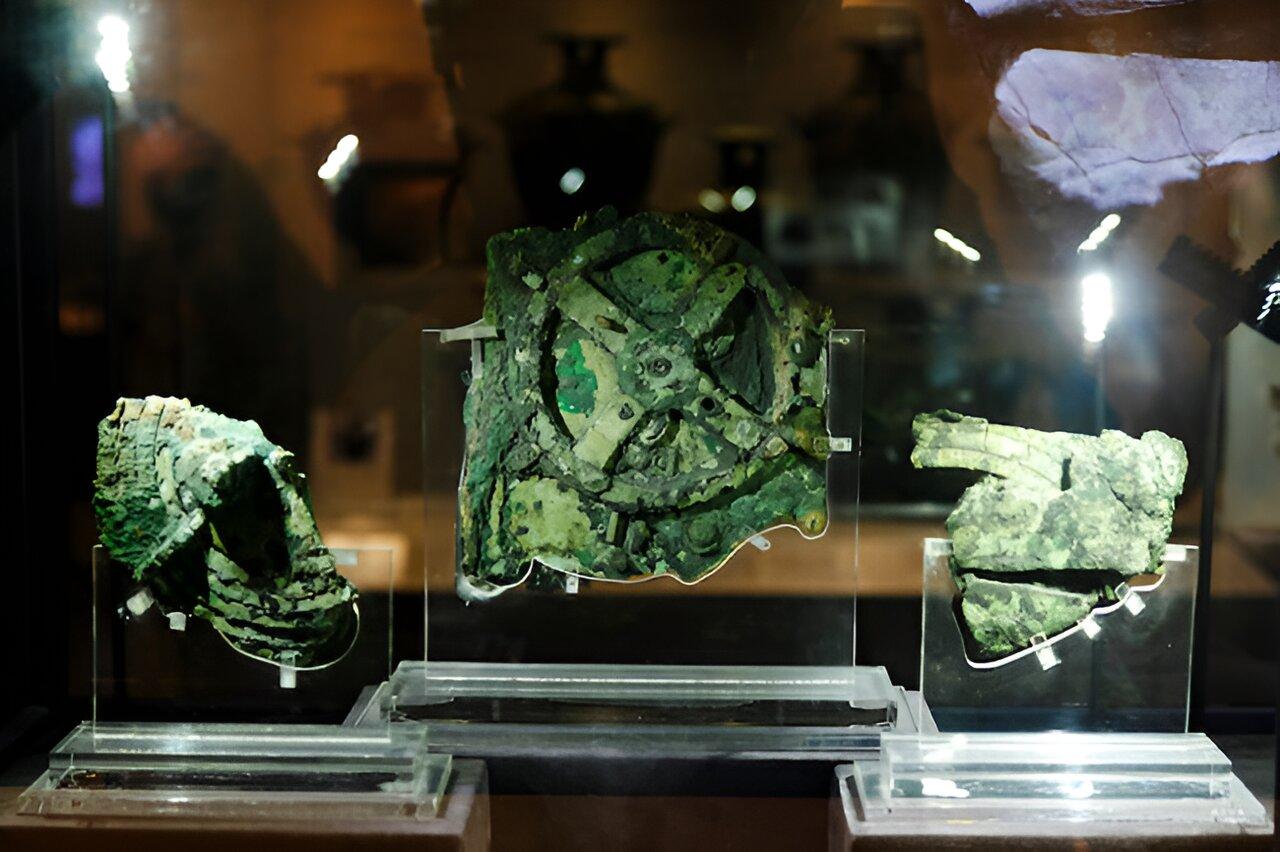
In 1900, Greek sponge divers exploring a Roman-era shipwreck off the coast of the island of Antikythera recovered a collection of statues, coins, and other ancient treasures. Among the artifacts was a heavily corroded lump of bronze that appeared unremarkable at first. It wasn’t until decades later, after careful examination and modern imaging techniques, that researchers realized they had discovered one of the most astonishing technological artifacts ever found: the Antikythera Mechanism, widely regarded as the world’s oldest known analog computer.
Built between 150 and 100 BC, the mechanism consisted of a sophisticated network of more than 30 finely crafted bronze gears enclosed within a wooden case roughly the size of a shoebox. By turning a hand crank, the user could model the movements of the heavens with remarkable precision. The device calculated the positions of the Sun, Moon, and the five planets known to the ancient Greeks—Mercury, Venus, Mars, Jupiter, and Saturn—while also tracking the phases of the Moon. Its front displayed a calendar and zodiac dial, while the back featured complex spiral dials capable of predicting solar and lunar eclipses using the Saros cycle, as well as a 19-year Metonic calendar used to synchronize lunar and solar years.

What makes the Antikythera Mechanism so extraordinary is not only its purpose but also its engineering. The intricate arrangement of precision-cut gears demonstrates a level of mechanical sophistication that historians once believed impossible for the ancient world. Comparable geared astronomical clocks and mechanical calculators would not appear in Europe again for well over a thousand years, making the device seem centuries ahead of its time.
Today, researchers continue to study the mechanism using advanced X-ray and 3D imaging, revealing hidden inscriptions and helping reconstruct how it originally worked.