
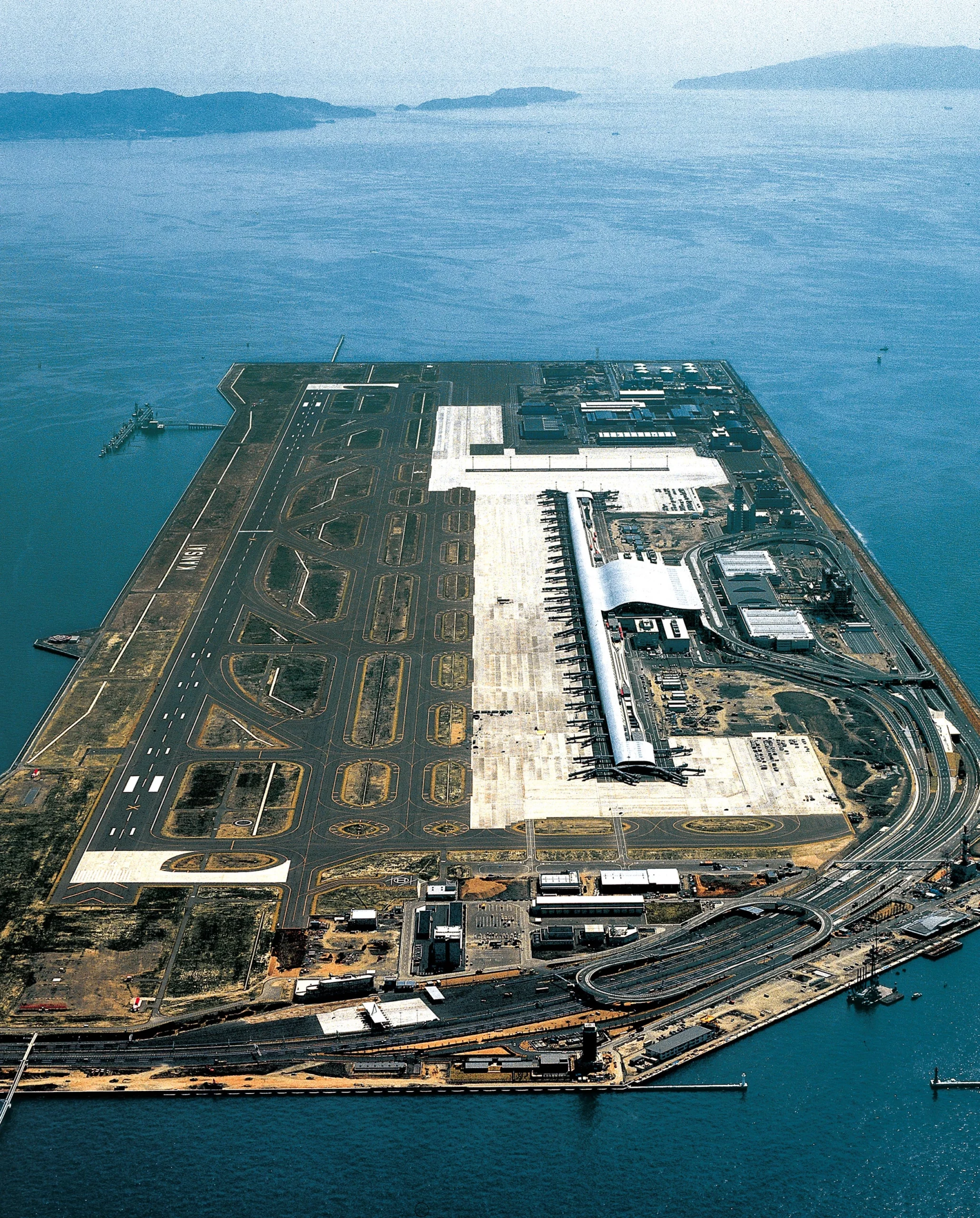
Japan’s Kansai region had a problem that seemed almost impossible to solve. Osaka needed a major international airport, but finding enough suitable land near the city was difficult. Building a huge airport inland would also create serious noise problems for surrounding communities. Engineers came up with an extraordinary solution: build the land first.
In January 1987, construction began on what would become Kansai International Airport. Engineers reclaimed land approximately 5 kilometers offshore in Osaka Bay, creating an enormous artificial island on which the airport could be built. The airport officially opened on September 4, 1994, becoming Japan’s first international airport capable of 24-hour operations.
But creating an island was only half the challenge. The artificial island was constructed over soft seabed, meaning engineers knew that the enormous weight of the reclaimed land would cause the ground to compress and settle. Engineers therefore had to design sophisticated systems to monitor and compensate for settlement over time.
The project eventually became one of Japan’s most ambitious examples of large-scale land reclamation and offshore engineering. And the story didn’t stop with one island. A second airport island was later constructed as part of Kansai’s expansion, allowing another runway and additional facilities to be developed.
Today, passengers arriving at Kansai aren’t simply landing at an airport beside the sea.